
Most shoe racks are returned for one boring reason: they do not fit. The rack is two inches too deep for the hallway, the door swings into it, or the shelf that was supposed to hold boots only fits flats. You can avoid all three problems with a tape measure and about ten minutes — before you spend anything. This guide walks through the four measurements that decide fit, the capacity math most product pages skip, and the material trade-offs that matter once the rack is in daily use. At the end, we run one real product through the full checklist so you can copy the process for any rack you are considering.
Specifications in the worked example were checked on the manufacturer’s product page on November 10, 2026.
For why the entryway rack matters as a design decision in the first place, see our earlier piece, The Shoes Rack Is One of the Most Underrated Design Decisions in Your Home.

The short answer
Measure the width of your wall space, the depth you can give up without blocking the walkway, the total height available, and the clearance between shelves your tallest everyday shoes need. Then count the pairs you actually wear each week — not every pair you own. A rack that fits your space but holds twice the shoes you need is wasted floor area; a rack that holds your shoes but blocks the door is worse. Fit first, capacity second, looks third.
Step 1: Measure width — and leave the door out of it
Measure along the wall where the rack will stand, skirting board to skirting board. Then check two things people forget:
- Door swing. Open the front door fully. If the rack sits inside the swing arc, measure again from where the door stops, not from the wall corner.
- Walkway clearance. After the rack is in place, you want a clear walking path in front of it. Size guides for entryway storage commonly recommend leaving at least 24 inches of open floor in front of the unit; more is better in a busy family hallway.
Standard freestanding shoe racks run roughly 24 to 48 inches wide, so most entryways have workable options — the question is which end of that range your wall actually allows.
The tape trick: mark the rack’s footprint on the floor with painter’s tape and live with it for a day. You will notice a blocked drawer, a tight squeeze, or a door conflict on paper long before a box arrives at your door.
Step 2: Measure depth against your longest shoe
Depth is the measurement that decides whether shoes sit on the shelf or hang off it. Most everyday adult shoes need a shelf around 12 to 14 inches deep. Narrow racks of 9 to 12 inches suit tight hallways and smaller shoes, while bulky sneakers and larger men’s sizes are more comfortable at 14 to 16 inches.
Measure your longest pair heel to toe, and compare it with the rack’s depth — not with the average shoe you own. If your longest pair overhangs by half an inch, that is cosmetic. If it overhangs by two inches, shoes will get knocked off every time someone passes.
Step 3: Check total height and shelf clearance separately
These are two different numbers, and product pages often give you only the first.
- Total height tells you whether the rack fits under a coat hook, a window sill, or a sloped stair ceiling.
- Shelf clearance — the vertical gap between one shelf and the next — tells you what fits on each shelf. As a working guide, flats and low sneakers need about 6 to 8 inches of clearance, high-tops and ankle boots about 8 to 12 inches, and tall boots usually will not fit between standard shelves at all; plan a floor spot or the top shelf for them.
A low 3-tier rack around 21 inches tall is an entryway piece, not a boot store. That is fine — as long as you know it before you buy.

Step 4: Do the capacity math the product page skips
Many racks, including the one in our worked example below, are sold without a stated pair count. So estimate it yourself:
- Take the rack’s usable shelf width in inches.
- Allow roughly 8 to 10 inches of width per pair of adult shoes (a single adult shoe is typically 3 to 4 inches wide, and pairs need a small gap).
- Divide, round down, and multiply by the number of shelves.
Rounding down matters. Manufacturers’ “up to” numbers usually assume narrow shoes packed tightly; your hallway math should assume real shoes with real space between them.
Step 5: Choose the material for how you actually live
| Material | Strengths | Trade-offs | Best for |
|---|---|---|---|
| Solid wood (e.g. pine) | Feels like furniture, repairable, warm look | Heavier than fabric; needs wiping, not soaking | Entryways you see all day |
| Woven shelves (PE wicker) | Airflow helps shoes dry; light; forgiving surface | Not a step stool — do not stand on it | Wet-weather shoes, daily pairs |
| Metal tube | Cheap, slim, strong per pound | Can look utilitarian; feet may scratch floors | Closets, garages, rentals |
| Fabric / non-woven | Lightest, cheapest, folds away | Sags under heavy shoes over time | Dorms, temporary setups |
| Closed cabinet | Hides everything, cleanest look | Less airflow; check depth carefully for big shoes | Minimalist entryways, pet homes |
Open racks ventilate better than closed cabinets — one reason woven or slatted shelves are popular for shoes that come in damp.

Worked example: running one real rack through the checklist
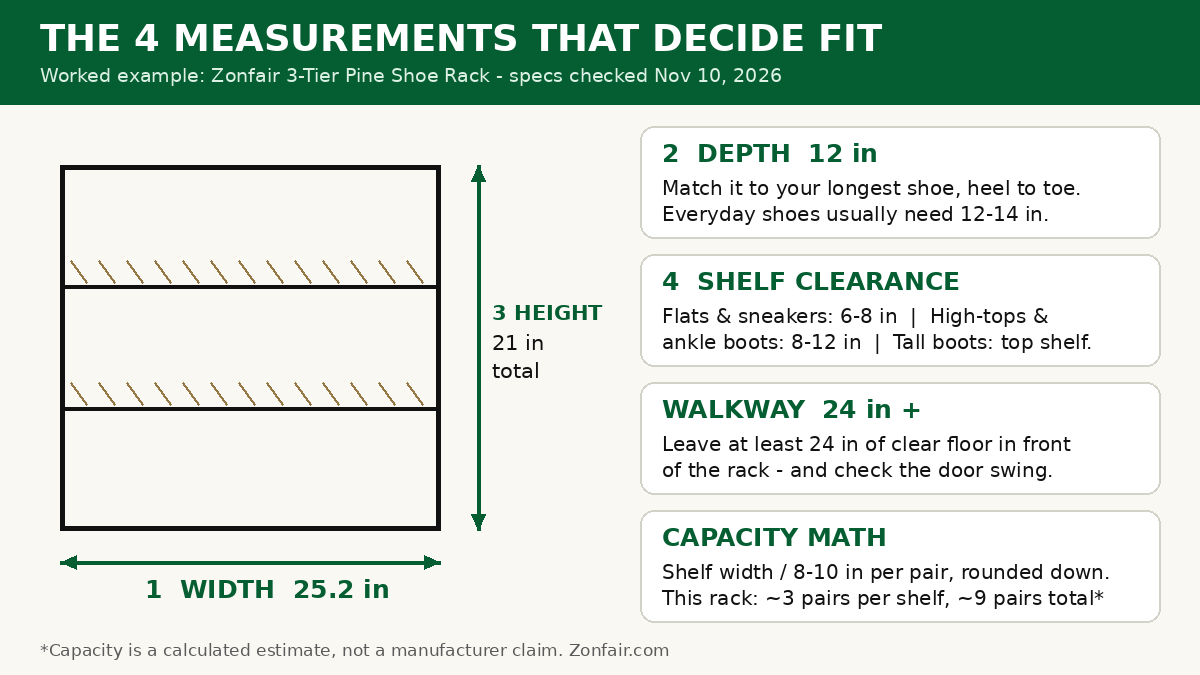
To show the process end to end, here is Zonfair’s Foldable Pine Wood Shoe Rack with PE Wicker Shelves (3-Tier) — solid pine with woven PE wicker shelves — scored against the five steps above, using the specifications published on its product page (checked November 10, 2026):
- Published size: 25.2 × 12 × 21 inches; weight 9.9 lbs; price $74.65 at the time of checking. Free US shipping on orders over $35, with delivery shown as 3–4 days on the product page.
- Width (25.2 in): sits at the compact end of the standard range — a small-to-typical entryway fit.
- Depth (12 in): matches the standard depth for everyday shoes. Larger, bulky sneakers will sit close to the edge; measure your longest pair first, per Step 2.
- Height (21 in, 3 tiers): a low profile that fits under most coat hooks. With three tiers inside 21 inches, shelf clearance suits flats, sneakers and low shoes; tall boots need a spot beside the rack, not on it. The product page does not publish per-shelf clearance, so treat boot storage as a no.
- Capacity (our estimate, not a manufacturer claim): the maker states no pair count. At 25.2 inches of width and 8 to 10 inches per pair, the math gives roughly 3 pairs per shelf, about 9 pairs across three shelves — a sensible size for one or two people’s daily rotation, not a whole family’s collection.
- Daily-life points in its favour: it folds flat when not in use, needs no assembly (“unfold and place,” per the maker), and at 9.9 lbs it is easy to move for cleaning. The woven shelves allow airflow, which helps damp shoes dry.
- What we cannot verify: the page lists no per-shelf weight limit and the product has no customer reviews yet, so we make no load or durability claims beyond the published specifications.

If your household’s daily rotation is around nine pairs or fewer and your entryway wall is at least 26 inches wide, this size class makes sense. If you counted 20 pairs in Step 4, skip this size entirely and look at a 36- to 48-inch-wide unit instead — no amount of good looks fixes a capacity problem.
Common mistakes to avoid
- Counting every pair you own. Store the season’s rotation by the door; the rest belongs in a closet. Entryway racks fail when they are asked to be the whole house’s shoe store.
- Ignoring the baseboard. A rack that is “exactly” your measured width often is not — skirting boards eat half an inch on each side.
- Buying for boots you rarely wear. If tall boots come out ten days a year, a floor corner serves them better than upsizing the whole rack.
- Skipping the tape test. Ten minutes with painter’s tape catches door swings and walkway problems that dimensions on a screen never will.
Frequently asked questions
What is the standard depth of a shoe rack?
Most shoe racks are about 12 to 14 inches deep, which suits most sneakers, flats and everyday adult shoes. Narrow models run 9 to 12 inches for tight hallways; bulky footwear is better at 14 to 16 inches.
How many pairs does a 3-tier shoe rack hold?
It depends on width. Allow 8 to 10 inches of shelf width per pair: a roughly 25-inch-wide 3-tier rack holds about 3 pairs per shelf, or around 9 pairs in total. Always check whether a stated capacity is a manufacturer figure or an estimate.
How much space should I leave in front of a shoe rack?
Plan for at least 24 inches of clear floor in front of the rack so the entryway stays walkable and the door opens fully.
Can a shoe rack hold tall boots?
Usually not between shelves. Standard shelf clearance fits flats, sneakers and ankle boots; tall boots generally need the top shelf or floor space beside the rack.
Is an open rack or a closed shoe cabinet better?
Open racks ventilate better and suit daily, sometimes damp shoes. Closed cabinets look tidier and keep dust and pets out, but check their depth carefully — doors eat into usable space.
The bottom line
A shoe rack is a measurement purchase disguised as a furniture purchase. Width, depth, height, shelf clearance, and an honest pair count will pick the right rack more reliably than any photo. Run those five numbers on any model you are considering — including ours — and the rack that arrives will be the rack that fits.
Written by the Zonfair Editorial Team. Product specifications were checked on the Zonfair product page on November 10, 2026; prices and shipping terms may change — the product page is the final source. Capacity figures labelled “our estimate” are calculated as described in Step 4 and are not manufacturer claims.
Sources consulted for standard dimensions: Tribesigns, “Shoe Rack Sizes: Finding the Perfect Fit for Your Space”; HomeyFad, “How to Pick the Right Entryway Shoe Storage Dimension?”; DeckUp, “Shoe Rack Size Guide” — standard ranges cross-checked across all three, November 10, 2026.