
Yes — for indoor furniture, acacia is one of the better-value hardwoods you can buy: the species commonly used for furniture are about as hard as oak, considerably harder than pine, and the grain is warm and lively in a way oak rarely is. But “acacia” is also one of the slipperiest labels in furniture. It names hundreds of species with meaningfully different hardness, and two products both sold as “acacia” can be built very differently — one solid throughout, one acacia only where you can see it. This guide gives you the honest numbers, the real pros and cons, and the label checks that tell you which kind you are actually buying.
Hardness figures below are from the USDA Forest Products Laboratory’s Wood Handbook and The Wood Database. Product details were checked on Zonfair’s product pages on November 10, 2026.
The short answer
If you want a table, bench or console for indoor daily use, acacia is a good choice: hard enough to resist everyday dents (roughly 1,160–1,430 lbf on the Janka scale for the species usually listed for furniture), strong for its weight, and typically sold at prices below comparable oak. Choose pine instead when budget, light weight or a painted finish matters more. Choose oak instead when you want the most consistent grain and colour, the easiest local supply, or — with white oak — the better natural outdoor durability. And whatever you choose, read the materials line closely: “acacia” on the title does not always mean solid acacia everywhere.
First, the catch: “acacia” is not one wood
Acacia is a huge genus. The furniture sold as acacia usually comes from a handful of species, and they do not measure the same:
- Plantation acacia (Acacia mangium) — the species behind much of the affordable acacia furniture exported from Southeast Asia — rates about 1,430 lbf Janka, just above white oak.
- Koa (Acacia koa) and Australian blackwood (Acacia melanoxylon) — the two acacias with long-standing entries in The Wood Database — rate about 1,170 and 1,160 lbf, a step below red oak but far above any pine.
- Hybrids and less common species fall in between and beyond, which is why retail pages quote wildly different “acacia hardness” numbers — sometimes honestly (a different species), sometimes by picking the biggest number available.
The practical takeaway: treat any single hardness figure for “acacia” with suspicion unless the seller names the species. The range above — call it oak-tier hardness, roughly 1,160–1,430 lbf — is the defensible claim for furniture-grade acacia.
The hardness numbers, honestly
The Janka test measures the force needed to press a steel ball halfway into the wood; higher numbers mean better resistance to dents and surface wear. It does not measure toughness, stability or rot resistance — a hard wood can still split or decay.
| Wood | Janka hardness (lbf) | What it means in a home |
|---|---|---|
| Eastern white pine | 380 | Dents with a dropped phone charger; fine for painted or low-contact pieces |
| Southern yellow pine | 690–870 | The toughest common pine — still clearly a softwood in daily use |
| Acacia (koa / Australian blackwood) | 1,160–1,170 | Hardwood territory; comparable to walnut-tier daily durability |
| Red oak | 1,290 | The US benchmark hardwood for floors and furniture |
| White oak | 1,360 | Slightly harder than red oak, with better moisture behaviour |
| Acacia (plantation A. mangium) | 1,430 | At or above white oak — the figure behind most “harder than oak” claims |
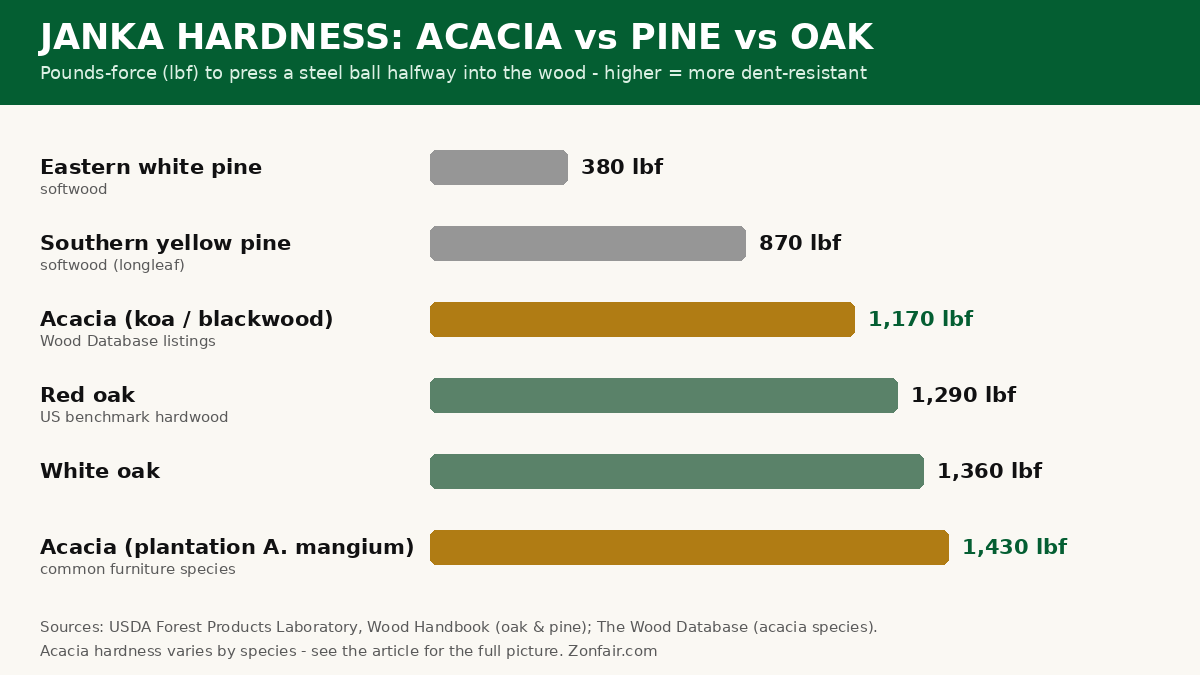
Eastern white pine 380 lbf; Southern yellow pine 870 lbf (longleaf); acacia (koa/blackwood) 1,170 lbf; red oak 1,290 lbf; white oak 1,360 lbf; plantation acacia A. mangium 1,430 lbf. Sources: USDA Wood Handbook; The Wood Database.
Two honest caveats. First, Janka values are lab averages on small clear samples — expect 5–15% variation between published charts and between individual boards. Second, for most indoor furniture, hardness past roughly 1,000 lbf stops being the deciding factor; joinery, finish and construction matter more. Acacia clears that bar comfortably. Pine does not — which is a trade-off, not a verdict, as the next sections show.
The pros of acacia furniture
- Dent resistance in oak’s league. At furniture-species values, acacia shrugs off the daily knocks — chair legs, keys, laptop corners — that mark up pine within months.
- Grain with actual character. Acacia’s colour runs from honey to deep brown, often with streaks and contrast between boards. If you find oak a little too uniform, acacia is the warmer, livelier-looking wood.
- Good strength for the weight. Acacia pieces are solid and reassuring without reaching the heft of dense oak builds of the same size.
- Value. Because much furniture acacia is plantation-grown and fast-growing, retail prices commonly land below comparable oak pieces — you are paying for a hardwood without paying oak’s premium for slow growth and US milling.
- Versatility of finish. It takes oil and clear finishes well, and its natural colour means many pieces need only a protective coat rather than a stain.
The cons — read these before you buy
- Colour and grain vary, a lot. Two boards in the same tabletop can differ visibly, and two separately bought pieces may not match. If you need a perfectly matched set, buy it at the same time from the same batch — or choose oak.
- It is not a naturally rot-proof outdoor wood. Decay resistance depends on the species, and some furniture acacias (koa, for example) are rated non-durable to perishable outdoors. Under a covered patio with a maintained finish, acacia does fine; left in wet ground contact, it will not outlast white oak or teak. Anyone selling acacia as “waterproof” is overselling.
- It is heavier than pine. A solid acacia console is a two-person carry for most people. If you rearrange rooms monthly or live in a walk-up, the weight is a real cost.
- The label can hide the construction. “Acacia” pieces may be solid, acacia-framed with other materials, or acacia-faced veneer over a different core. That is not automatically bad — veneer can be stable and looks identical on day one — but you should know which you are paying for. See the label check below.
- Sun and water still apply. Like most woods, acacia can fade in prolonged direct sun and mark if hot or wet items sit on an unprotected finish. Coasters are not optional decoration.
Acacia vs pine: when the cheaper wood honestly wins
Pine is the default budget furniture wood, and sometimes it is the right answer:
- Choose pine when the piece will be painted (its grain is plain anyway), when it must be light and easy to move, when it is a utility piece — shelving, a closet rack, a shoe rack in a hallway — or when the budget is the budget. Our own entryway example: the foldable shoe rack in our shoe rack size guide is solid pine with woven shelves precisely because a rack gets kicked, dripped on and folded away, and pine’s softness costs nothing there.
- Choose acacia when the surface is the point — a tabletop you eat at, a bench seat, a console in full view — and when you want that surface to look close to new in five years rather than charmingly battered in one.
The honest summary: pine dents, acacia mostly does not; pine is light and cheap, acacia is neither. Match the wood to how hard the piece will be used, not to which sounds more premium.
Acacia vs oak: closer than the marketing suggests
- Hardness: effectively a tie at the top end (plantation acacia 1,430 lbf vs white oak 1,360 lbf), with koa/blackwood acacias a step below the oaks. Nobody’s tabletop survives or fails on a 70-lbf difference.
- Look: oak is straighter-grained and more consistent in colour; acacia is warmer, browner and more varied. This is a taste decision, not a quality one.
- Outdoors: white oak wins — its closed grain structure handles moisture better than furniture acacias. Indoors, the advantage disappears.
- Price and supply: oak is the easier wood to match, repair and extend a set with in the US market, and priced accordingly. Acacia usually costs less up front; matching a second piece years later is the gamble.
The label check: what “acacia” actually bought you
Before paying, read the product page’s materials and specification lines for three things: (1) does it say solid acacia, and for which parts? (2) what are the dimensions and the product’s actual weight (solid hardwood has heft — a suspiciously light “solid acacia” table deserves a question)? (3) is the construction knock-down (KD) flat-pack or assembled joinery?
Here is that check run on three pieces from our own catalogue — including the part most sellers would rather you skimmed past (details checked November 10, 2026):
| Product | Price | Size (in) | Weight | What the materials line actually says |
|---|---|---|---|---|
| Acacia Solid Wood Console Table with Open Shelving | $258.96 (was $275.99) | 47.24 × 13.97 × 31.49 | 39.7 lbs | Solid acacia wood, decorative side panels, smooth painted finish, KD construction |
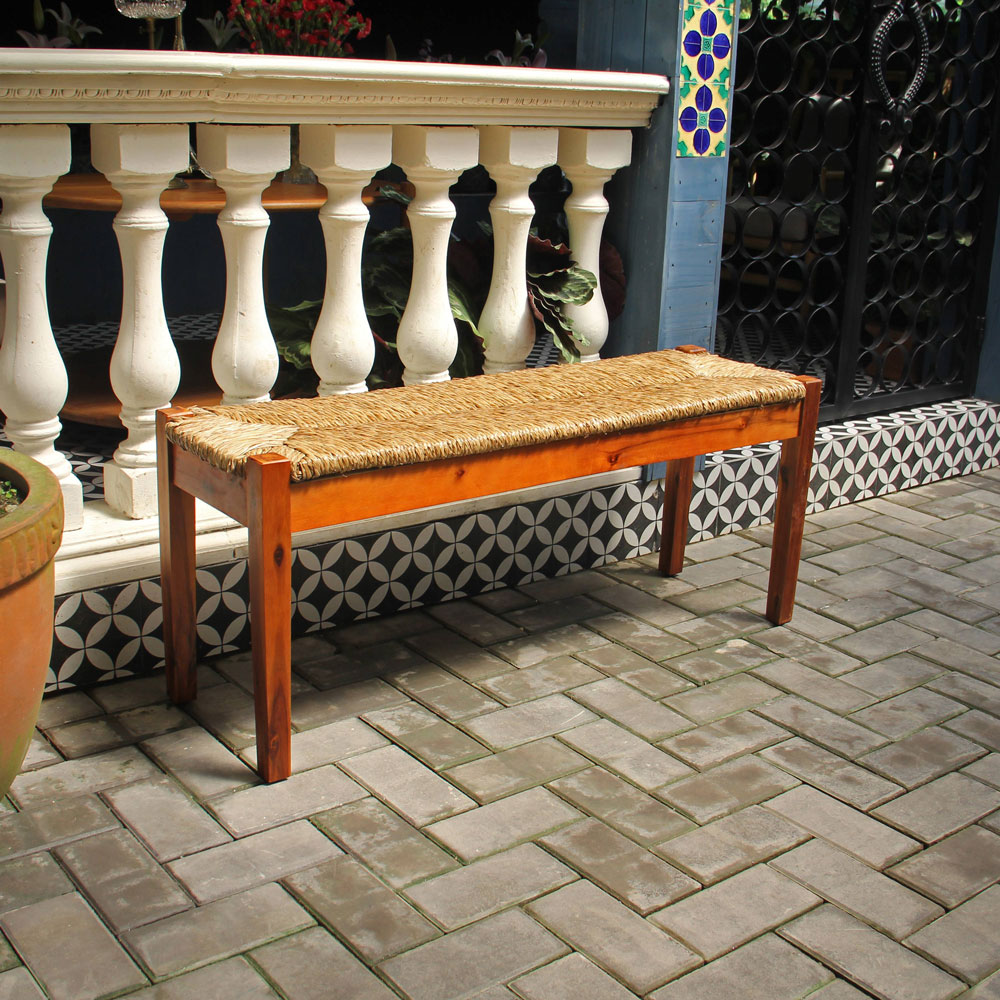
| Handmade Acacia Wood Indoor Bench with Seagrass Woven Seat | $198.58 | 46.45 × 13.77 × 19.29 | 18.5 lbs | Solid acacia frame with a hand-twisted natural seagrass woven seat, KD structure |
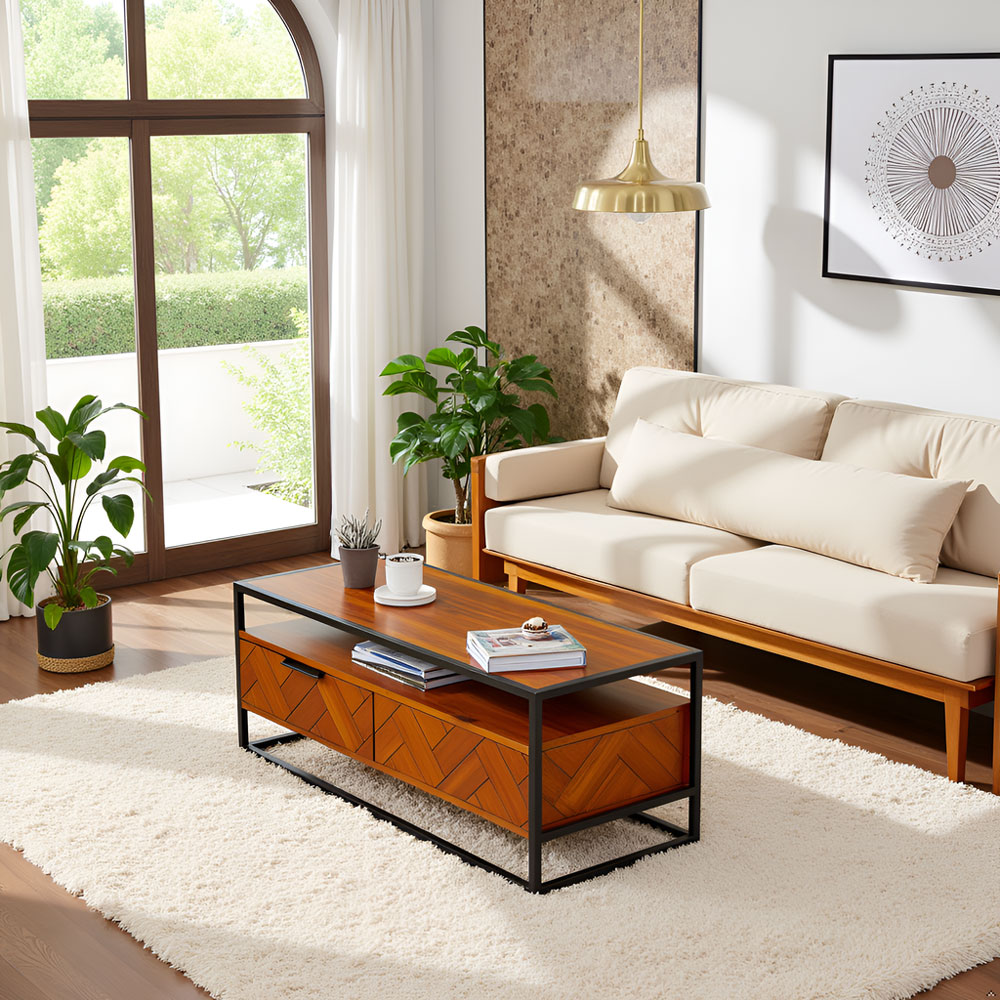
| Acacia Wood Coffee Table with 2 Drawers & Steel Frame | $502.68 | 43.31 × 19.69 × 18.9 | 64.37 lbs | Acacia wood with a pine veneer exterior, powder-coated steel frame, two drawers, KD construction |
Read the third row again: our most expensive acacia-titled piece is the one that is not solid acacia on the outside — it pairs acacia with a pine veneer exterior over a steel frame. That is a legitimate construction (the steel frame is why it can carry drawers at that span, and 64 lbs is no lightweight), but it proves the rule of this whole guide: the title sells the wood; the specification tells the truth. Any seller — including us — should be read that way.
A second honesty note: all three products currently have no customer reviews on our site, so we make no claims here about how they wear beyond the published specifications and the wood data above.
Caring for acacia, briefly
Daily care is simple: dust with a soft cloth, wipe spills promptly, and use coasters under hot or wet items. Keep indoor pieces out of prolonged direct sun where you can, and follow the maker’s finish instructions before applying any oil or wax — the right product depends on the finish your piece actually has, and the product page or maker is the correct source for that, not a generic internet recipe. Outdoor or patio acacia needs its finish maintained and a covered spot; treat “suitable for covered outdoor use” and “outdoor-proof” as the very different claims they are.
Frequently asked questions
Is acacia wood harder than oak?
It depends on the species. Plantation acacia (A. mangium, about 1,430 lbf Janka) rates slightly above white oak (1,360 lbf) and red oak (1,290 lbf). Koa and Australian blackwood (about 1,160–1,170 lbf) rate slightly below the oaks. All of them sit far above pine (380–870 lbf).
Is acacia wood waterproof?
No. Acacia resists everyday splashes better than softwoods, and a maintained finish helps, but it is water-resistant at best — standing water, wet ground contact and unmaintained outdoor exposure will damage it, as with most furniture woods.
Does acacia wood scratch easily?
No — dent and scratch resistance is its strength. At furniture-species hardness (roughly 1,160–1,430 lbf), it marks far less readily than pine. Sharp point loads and grit dragged across the finish can still scratch any wood, acacia included.
Is acacia good for outdoor furniture?
For covered outdoor use with a maintained finish, yes. For fully exposed, ground-contact, leave-it-all-winter use, white oak, teak or purpose-built outdoor materials are the safer choice — acacia’s decay resistance varies by species and is not its strongest property.
Why does acacia furniture vary so much in colour?
Because “acacia” covers many species and fast-grown plantation timber with naturally variable heartwood. Expect honey-to-dark-brown variation between boards — it is the wood’s signature look, and the reason to buy matching pieces in the same batch.
The bottom line
Acacia is good furniture wood — genuinely hard, characterful and fairly priced — provided you buy the species-and-construction reality rather than the one-word label. Check that the hardness claim names a species, that the materials line says what is solid and what is not, and that the weight matches the story. Do those three checks and acacia will usually beat pine on durability and oak on price, which is exactly the corner of the market it has earned.
Written by the Zonfair Editorial Team. Hardness data: USDA Forest Products Laboratory, Wood Handbook (Wood as an Engineering Material), Chapter 5; The Wood Database species entries for koa and Australian blackwood; plantation acacia (A. mangium) figure as compiled from The Wood Database data. Product prices, dimensions and materials checked on Zonfair product pages on November 10, 2026 — prices and specifications may change; the product page is the final source.